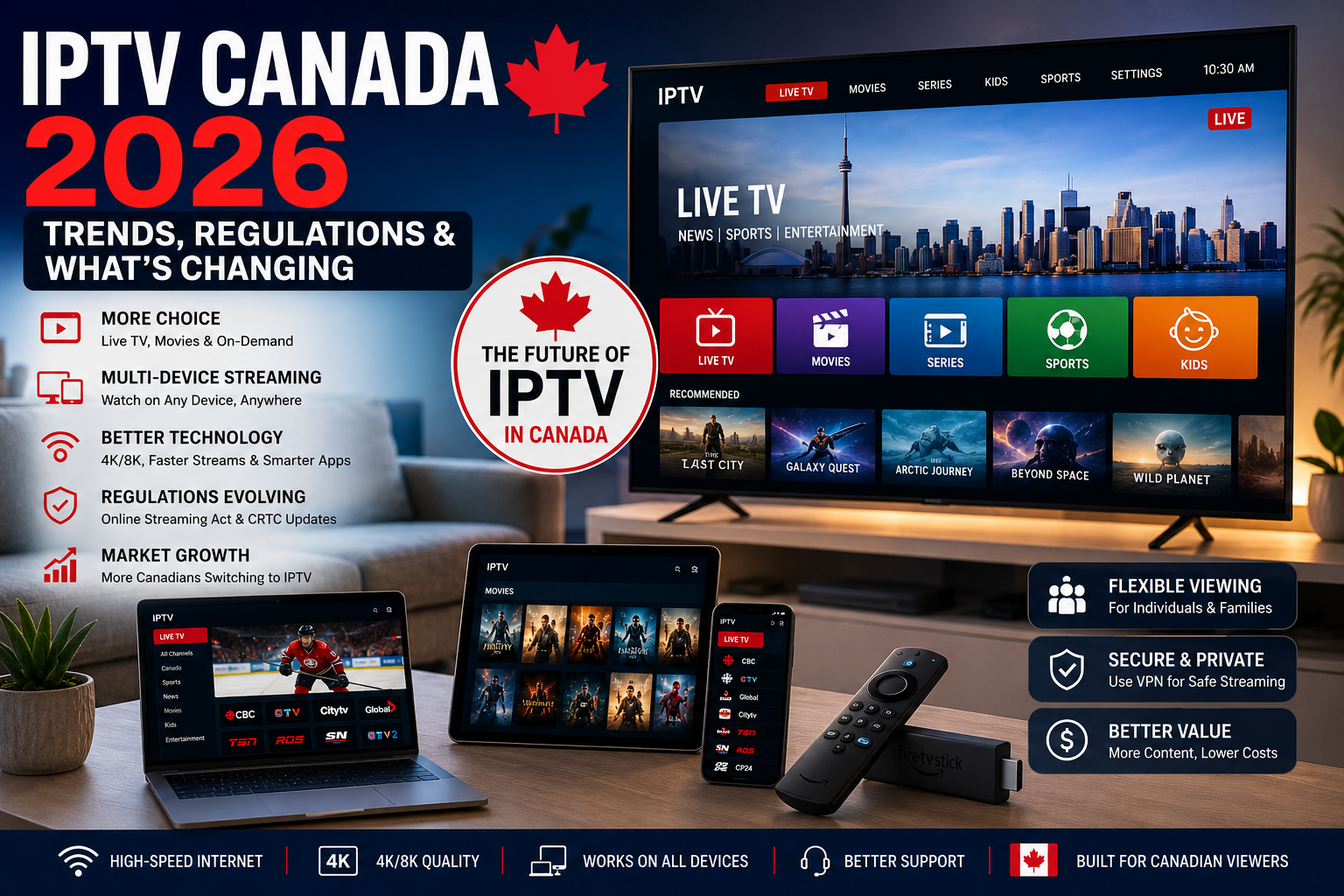
The IPTV market in Canada is changing fast. Viewers now expect more flexibility, better picture quality, easier setup, stronger device support, and clearer information before choosing a service. Because of this, IPTV Canada 2026 is not only about watching live TV online. It is about how Canadians use internet-based entertainment across Smart TVs, Firestick, Android TV, mobile devices, tablets, and streaming apps.
For many years, traditional cable was the normal way to watch live TV at home. However, Canadian viewing habits have changed. More people now want content that works across different devices, offers live channels and on-demand options, and fits modern home entertainment habits. IPTV has become part of that shift because it gives users a more flexible way to watch content through an internet connection.
At the same time, the Canadian broadcasting and streaming landscape is becoming more regulated. The CRTC continues to modernize the broadcasting framework after the Online Streaming Act changed the Broadcasting Act in 2023. The CRTC says this modernization is meant to make Canadian and non-Canadian online undertakings contribute to the Canadian broadcasting system and support Canadian, Indigenous, French-language, and other local content. (CRTC)
For viewers, this means 2026 is an important year. IPTV users should pay attention to service quality, legal clarity, device compatibility, internet speed, customer support, and provider transparency. If you are comparing options, you can start with the main IPTV Canada page from Primestelly IPTV.
In this guide, we will explain the current state of IPTV in Canada, the newest technology trends, how CRTC regulations are evolving, what market growth shows, and what Canadian viewers may expect through 2027.
The Current State of IPTV in Canada
The current IPTV market in Canada is shaped by one major trend: viewers want more control. They do not want to be limited to one cable box, one room, or one fixed package. Instead, they want live TV, movies, series, sports, and international content available through apps and internet-connected devices.
This is why IPTV continues to attract Canadian households. A good IPTV setup can work on Smart TVs, Firestick, Android TV boxes, phones, tablets, and computers. As a result, users can watch in the living room, bedroom, kitchen, or even while travelling.
However, the IPTV market is not only growing because of convenience. It is also growing because traditional TV habits are changing. The CRTC reported that Canadians continue to increase their consumption of online content, including video-on-demand and streaming subscriptions. It also noted that online undertakings were the only broadcasting sector with significant revenue growth in the 2024 broadcast year. (CRTC)
This does not mean traditional TV has disappeared. Cable and other TV providers still serve millions of Canadians. According to the CRTC’s current trends page, the latest quarter available showed television service providers with 8.64 million subscribers, although that number had declined by 0.7% compared with the previous quarter. The same CRTC update also showed audiovisual streaming hours increasing by 13.4% quarter over quarter. (CRTC)
This shows the market is moving in two directions at once. Traditional TV still exists, but streaming and internet-based viewing are becoming more important. For IPTV Canada 2026, this creates a clear opportunity for providers that can offer stable service, easy setup, and strong customer support.
Canadian users now care about:
- Stable streams during peak hours
- HD and 4K quality where available
- Simple app setup
- Smart TV and Firestick compatibility
- Clear subscription options
- Helpful support
- Multi-device access
- Organized channel categories
- EPG guide accuracy
- Safer and more transparent service information
This is also why users now read more before buying. They compare providers, look for reviews, test trials, and check whether the service works on their device. For example, many users now read IPTV Canada reviews before choosing a provider.
The current state of IPTV in Canada is simple: demand is growing, expectations are higher, and users are becoming more careful.
New IPTV Features and Technology in 2026
IPTV technology in 2026 is becoming more user-focused. In the past, many IPTV services were judged mainly by the number of channels they offered. Now, Canadian users care more about the full experience. They want the service to feel smooth, organized, and easy to use.
One of the biggest trends is better app compatibility. Users want IPTV to work on the devices they already own. This includes Smart TVs, Firestick, Android TV, Android phones, iPhones, tablets, laptops, and desktop computers. A provider that only works well on one device may feel limited in 2026.
Another major trend is multi-device viewing. Families and shared households often need IPTV on more than one screen. One person may watch sports on the main TV, another may watch movies in another room, and someone else may use a tablet. Because of this, more users now ask about connection limits before buying. You can learn more in the IPTV multiple devices Canada guide.
Stream stability is also improving as viewers expect fewer interruptions. Buffering is still one of the biggest complaints in IPTV, but users now understand that buffering can come from several causes. It may come from the provider, but it can also come from weak Wi-Fi, old devices, overloaded apps, or slow internet.
In 2026, strong IPTV providers focus more on setup guidance. They help users choose the right app, refresh playlists, clear cache, restart devices, and improve Wi-Fi performance. This type of support can make the difference between a frustrating setup and a smooth experience.
Another feature trend is better EPG support. The Electronic Program Guide helps users see what is playing now and what comes next. For people switching from cable, a good EPG makes IPTV feel more familiar. It also helps users browse channels faster.
Video-on-demand is also becoming more important. Many users do not only want live TV. They also want movies, series, family content, and on-demand entertainment. Because of this, a strong IPTV provider should offer a well-organized VOD section that is easy to browse.
For families, parental controls and kids’ content are becoming more important. Parents want entertainment options for the whole household, but they also want better control over what children can access. The IPTV for families Canada guide explains this in more detail.
The main IPTV technology trends in 2026 include:
- Better Smart TV support
- More Firestick and Android TV compatibility
- Multi-device connection options
- Improved EPG organization
- Larger and cleaner VOD libraries
- Faster activation
- Better support for app setup
- More focus on stream stability
- Family-friendly features
- Clearer subscription plans
For Primestelly IPTV, these trends matter because Canadian users want a service that feels modern and simple. The goal is not only to provide access. The goal is to make IPTV easier to use every day.
How CRTC Regulations Are Evolving
The regulatory side of streaming in Canada is one of the biggest topics in 2026. The Online Streaming Act came into force on April 27, 2023, and changed the Broadcasting Act. The CRTC says these changes require it to modernize the broadcasting framework and ensure that online undertakings contribute to the Canadian broadcasting system. (CRTC)
This matters because the line between traditional broadcasting and online streaming is becoming less clear. Canadians now watch content through cable, apps, streaming platforms, IPTV services, Smart TVs, and mobile devices. Regulation is trying to catch up with how people actually consume content.
In 2025 and 2026, the CRTC continued building this modernized framework. One important direction is financial contribution. Recent reporting on the CRTC’s May 2026 decision said large online streaming services must contribute 15% of their Canadian revenues to Canadian content, which includes the earlier 5% base contribution requirement. The rules apply to larger services meeting Canadian revenue thresholds. (AP News)
For everyday IPTV users, this does not mean every service works the same way or follows the same rules. It does mean the broader Canadian streaming market is under more attention. Regulation around online undertakings, Canadian content, discoverability, accessibility, and financial contributions is becoming more active.
This is why viewers should care about legal clarity. Not every IPTV provider operates in the same way, and not every content source has the same rights. Before choosing a provider, users should understand the basic legal landscape. The guide on is IPTV legal in Canada explains this topic in simple terms.
It is also useful to read more about the Online Streaming Act impact in Canada, especially if you want to understand how regulation affects streaming platforms, viewers, and the Canadian entertainment market.
For providers, 2026 is a year where transparency matters more. Users want clear information about plans, setup, renewal, support, and service expectations. They do not want vague claims or confusing terms.
For viewers, the best approach is simple:
- Read the provider’s information carefully
- Ask questions before buying
- Test the service when possible
- Understand what the subscription includes
- Check device compatibility
- Review legal information
- Choose a provider with clear support
CRTC regulation will likely continue evolving. However, from a customer point of view, the most important thing is choosing an IPTV service that is clear, stable, and easy to use.
Market Growth — How Many Canadians Use IPTV Now?
There is no single public number that counts every IPTV user in Canada. This is because IPTV can mean different things depending on context. It can refer to telecom TV delivered over internet protocol, app-based streaming TV, legal online TV services, or general internet-based live TV viewing.
Because of that, the better way to understand growth is to look at viewing trends. Official CRTC data shows that Canadian TV habits are shifting toward online content. The CRTC’s annual broadcasting highlights reported that streaming-only households increased from 23% in 2023 to 29% in 2024, based on MTM Fall 2024 adoption data. (CRTC)
This is a strong sign that more households are moving away from traditional TV bundles or using online-first entertainment. It does not mean every streaming-only household uses IPTV. However, it does show that Canadians are increasingly comfortable watching content through internet-based platforms.
The CRTC’s current trends page also showed audiovisual streaming at 2.83 billion hours, with a 13.4% quarterly increase, while traditional television tuning decreased by 1.8% quarter over quarter. (CRTC)
For IPTV Canada 2026, this trend is important. IPTV fits into the larger movement toward flexible, internet-based viewing. People want to watch what they want, when they want, and on the device they prefer.
The strongest IPTV growth areas in Canada include:
- Households replacing cable
- Families needing multiple screens
- Firestick and Android TV users
- Smart TV viewers
- Sports fans
- International content viewers
- Bilingual English and French households
- Users looking for flexible subscription options
- Viewers comparing IPTV with cable costs
Cost is one of the main reasons people explore IPTV. Cable bills can feel expensive, especially when users pay for channels they rarely watch. IPTV can feel more flexible because users can choose app-based viewing and often access many categories through one setup.
However, growth also brings more competition. Many providers now use similar claims, such as large channel lists, HD quality, fast activation, and stable servers. This is why customers should compare more than price. They should check reviews, support, setup quality, and device compatibility.
A useful first step is testing the service. The IPTV Canada free trial guide explains what users should check before paying. This is especially helpful for new customers who want reassurance before choosing a full plan.
Another important step is comparing subscriptions. The IPTV subscription Canada page can help users understand what to look for before buying.
In short, IPTV use is growing because Canadian viewing habits are changing. More people want flexible, app-based access. More households are streaming. More users want content across devices. These trends make IPTV part of the future of home entertainment in Canada.
Predictions for IPTV in Canada Through 2027
The IPTV market in Canada will likely continue changing through 2027. Viewers are becoming more selective, and providers will need to offer a better experience to stay competitive.
The first prediction is that multi-device IPTV will become even more important. Canadian homes now use many screens, and users want entertainment to follow them from room to room. Providers that offer clear connection options will have an advantage.
The second prediction is that setup support will become a major selling point. Many users are comfortable with streaming, but IPTV setup can still confuse beginners. Providers that explain Smart TV setup, Firestick setup, app login, EPG refresh, and troubleshooting will earn more trust.
The third prediction is that IPTV reviews will matter more. As the market becomes crowded, users will rely more on customer feedback. They will search for real experiences before paying. This is why IPTV Canada reviews can help customers compare providers more carefully.
The fourth prediction is that families will become an important IPTV audience. Parents want kids’ content, parental controls, multiple screens, and good value. IPTV providers that support family viewing will have a stronger position.
The fifth prediction is that regulation will keep shaping the broader streaming market. The CRTC is still modernizing the broadcasting framework, and online platforms are now part of that conversation. For viewers, this means legal awareness and provider transparency will remain important.
The sixth prediction is that quality will matter more than channel count. In the past, many users looked only at how many channels a provider offered. In 2026 and beyond, more users will care about stream stability, support, organized categories, EPG quality, and device performance.
The seventh prediction is that IPTV will become more local and more personalized. Canadian users often want content that fits their region, language, device, and household. Providers that understand Canadian viewing habits will stand out.
Through 2027, the best IPTV providers in Canada will likely be the ones that offer:
- Clear plans
- Stable streaming
- Strong support
- Device flexibility
- Multi-connection options
- Simple setup
- Honest information
- Good family features
- Helpful guides
- Better long-term reliability
Primestelly IPTV is positioned around these needs by focusing on Canadian viewers, clear setup, device compatibility, and a flexible IPTV experience.
For users, the best advice is to choose carefully. Do not buy only because a provider claims to have many channels. Instead, look at the full experience. Check support, setup, reviews, trial options, device compatibility, and plan details.
To continue exploring the full cluster, you can read these related guides:
- IPTV Canada free trial
- IPTV Canada reviews
- IPTV for families Canada
- IPTV multiple devices Canada
- Best IPTV service in Canada
- IPTV subscription Canada
- How to set up IPTV service in Canada
- IPTV Firestick Canada
- IPTV Smart TV Canada
- IPTV vs cable Canada
- IPTV channel list Canada
- Best VPN for IPTV Canada
- Is IPTV legal in Canada?
- Online Streaming Act impact in Canada
The future of IPTV in Canada is not only about more content. It is about better access, better support, better device compatibility, and better trust. That is what Canadian viewers will expect in 2026 and beyond.
FAQ
What is IPTV Canada 2026?
IPTV Canada 2026 refers to the current IPTV market, features, regulations, and viewing trends in Canada. It includes live TV streaming, app-based viewing, Smart TV support, Firestick setup, multi-device access, and changing Canadian streaming rules.
Is IPTV growing in Canada?
Yes, internet-based viewing is growing in Canada. CRTC data shows streaming-only households increased from 23% in 2023 to 29% in 2024, and audiovisual streaming hours increased in the latest current trends update. (CRTC)
How many Canadians use IPTV now?
There is no single public number for all IPTV users in Canada because IPTV can refer to different types of internet-based TV services. However, CRTC data shows millions of Canadians still subscribe to TV service providers, while streaming-only households and audiovisual streaming hours continue to grow. (CRTC)
What are the biggest IPTV trends in Canada for 2026?
The biggest IPTV trends include multi-device streaming, Smart TV support, Firestick compatibility, better EPG guides, improved VOD libraries, family-friendly features, faster activation, and stronger customer support.
How are CRTC regulations changing streaming in Canada?
The CRTC is modernizing Canada’s broadcasting framework after the Online Streaming Act changed the Broadcasting Act. The goal is to bring online undertakings into the broader Canadian broadcasting system and require meaningful contributions to Canadian content. (CRTC)
Does the Online Streaming Act affect IPTV users?
The Online Streaming Act mainly affects the broader broadcasting and online streaming framework. For users, the main impact is that streaming regulation is becoming more active in Canada. Viewers should choose providers carefully and understand the legal side before buying.
Is IPTV legal in Canada?
IPTV can be legal when the provider has the proper rights to distribute content. However, not every IPTV service operates the same way. Users should read the is IPTV legal in Canada guide before choosing a provider.
What devices are best for IPTV in Canada?
Popular IPTV devices in Canada include Smart TVs, Firestick, Android TV boxes, Android phones, iPhones, tablets, laptops, and desktop computers. The best device depends on your app, internet connection, and viewing habits.
Will IPTV replace cable in Canada?
IPTV may not fully replace cable for everyone, but it will continue to compete with traditional TV because many users want flexibility, lower costs, and access across multiple devices. Streaming habits are growing, while traditional TV subscriber numbers continue to face pressure.
What should I check before buying IPTV in 2026?
Before buying IPTV, check device compatibility, stream stability, customer support, channel categories, VOD quality, EPG accuracy, connection limits, plan terms, and legal information.
Is IPTV good for families in Canada?
Yes, IPTV can be good for families when the provider offers stable streams, kids’ content, multi-device options, parental control support, and simple setup. Families should choose a plan that supports the number of screens they need.
Should I test IPTV before paying?
Yes, testing IPTV before paying is a smart idea. A trial helps you check stream quality, device compatibility, support response, EPG performance, and whether your favourite channels work well.
What makes Primestelly IPTV useful for Canadian viewers?
Primestelly IPTV is designed for Canadian users who want flexible IPTV access, device compatibility, simple setup, and helpful support. It can be a strong option for viewers comparing IPTV services in Canada.
What is the future of IPTV in Canada?
The future of IPTV in Canada will likely focus on better streaming quality, clearer legal information, stronger device support, multi-screen access, family features, and more transparent subscription options.
All 5 articles from the uploaded remaining cluster are now complete.