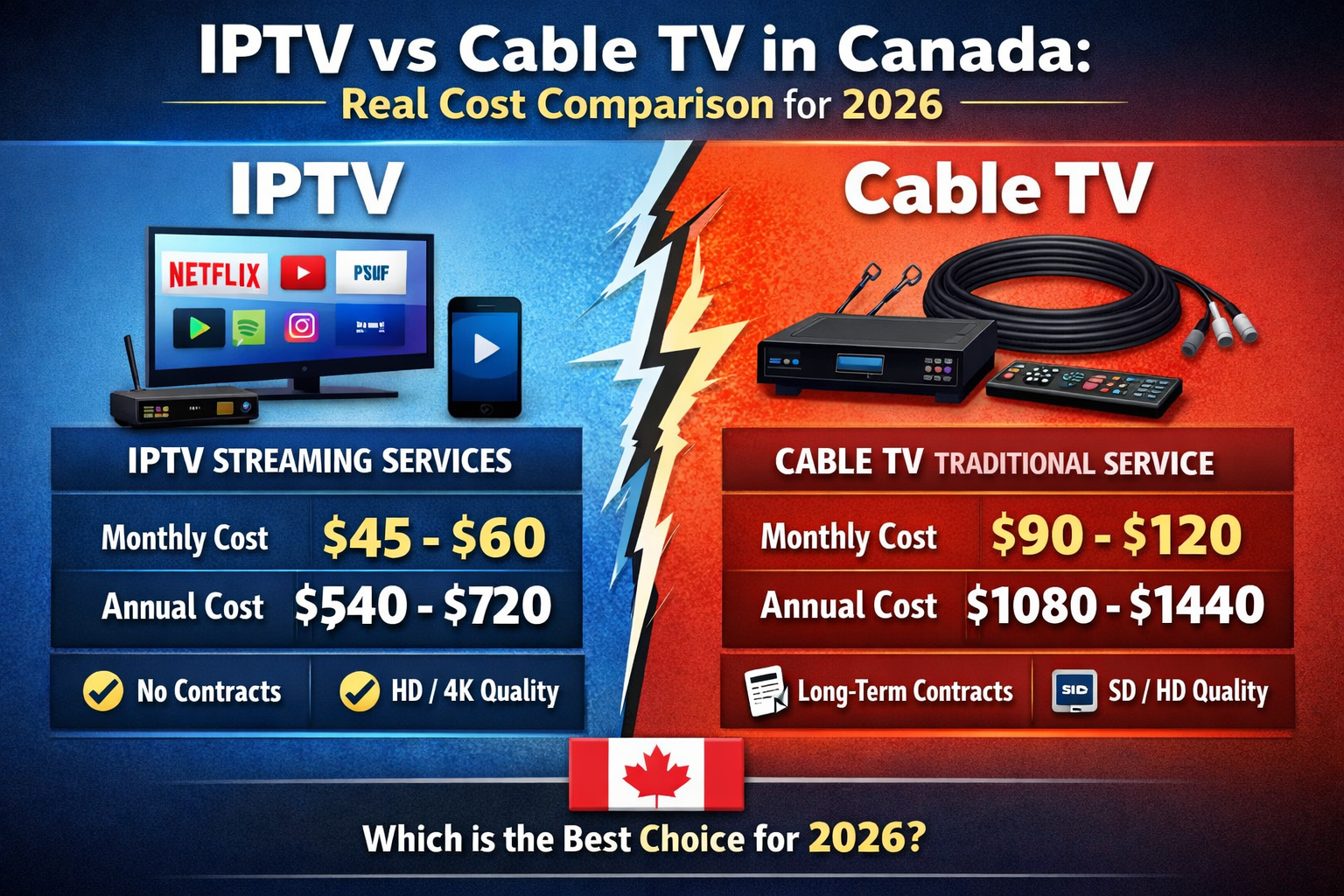
More Canadians are now comparing IPTV vs cable Canada because the price of traditional television keeps rising. At the same time, many households want more flexibility, more channels, and fewer hidden costs. As a result, people are asking a simple question: is cable still worth it in 2026?
The answer depends on what matters most to you. Some people want local channels and familiar packages. Others want more freedom, better value, and easier access across devices. That is why many viewers now explore IPTV Canada as an alternative to old-style TV services.
Before choosing one option, it helps to understand the real difference between them. For example, if you are still learning about available services, you can also check this guide to the best IPTV service and compare it with what cable companies offer today.
In this guide, we will look at cost, channel variety, flexibility, picture quality, hidden fees, and daily user experience. Therefore, if you want to know whether IPTV vs cable TV in Canada is the better choice for your home, this article will make it much easier to decide.
What Does Cable TV Actually Cost in Canada?
Cable TV has been part of Canadian homes for many years. However, the biggest reason many families are moving away from it is the price. At first, cable may seem simple. You choose a provider, pick a package, and install the service. Yet the real monthly cost is often much higher than people expect.
In many cases, the advertised price only shows the basic package. After that, you may have to pay for sports add-ons, movie bundles, HD features, box rentals, installation, or extra room access. Because of that, the final bill can become expensive very quickly.
Bell-style cable packages
Many traditional TV packages in Canada begin with a base plan and then increase depending on channels and features. If you want sports, premium movie content, or more flexibility, you usually need to move to a higher package. Consequently, families often end up paying far more than they planned.
Rogers-style cable packages
Another common issue is that some cable providers encourage bundling. While internet and TV together may seem convenient, it can also make it harder to understand the true TV cost. In other words, you may feel like you are getting a deal, but the television portion is still expensive.
Telus, Shaw, and similar providers
Across different provinces, the pattern is usually the same. Basic television looks affordable, but premium viewing becomes costly. Moreover, if you want multiple boxes or advanced features, your monthly total rises again.
For many households, cable can easily feel outdated because it locks them into a rigid structure. Although some people still like the familiarity of cable, others want a setup that feels more modern and less restrictive.
How Much Does IPTV Cost in Canada?
When people compare IPTV vs cable Canada, price is often the first reason they look at IPTV. In general, IPTV tends to be more flexible and more affordable. Instead of paying for a bundle with several locked features, users often get access to a broad content library under one subscription model.
That does not mean every IPTV option is the same. Some services offer more device support, better stream quality, more channel categories, and stronger customer assistance than others. Even so, many users still find that IPTV gives them better value than cable.
Another major benefit is that IPTV often works across more than one type of device. So instead of being tied to a single television box, people can watch on smart TVs, streaming devices, phones, tablets, and sometimes laptops as well. If you need help with setup, this step-by-step guide on how to set up IPTV service in Canada explains the process clearly.
Because of this flexibility, IPTV feels more aligned with how people watch TV in 2026. Users no longer want to be stuck in one room, with one box, on one provider’s schedule.
IPTV vs Cable Canada: The Core Difference
The biggest difference between IPTV and cable is how content is delivered.
Cable uses older infrastructure and fixed service models. On the other hand, IPTV delivers channels and media over internet-based systems. As a result, IPTV usually offers more freedom, wider compatibility, and more scalable options for modern households.
That difference changes the full viewing experience.
With cable, you often get:
- fixed packages
- equipment dependency
- limited portability
- contract pressure
- extra charges for upgrades
With IPTV, users often prefer:
- more flexible access
- wider content availability
- support for many devices
- simpler setup options
- easier control over how and where they watch
Therefore, the comparison is not only about price. It is also about convenience, personalization, and how well each option fits modern digital habits.
Channel Selection: What Do You Really Get?
One of the strongest reasons people search for IPTV vs cable TV in Canada is channel selection. After all, no one wants to pay more for less content.
Cable usually gives you a local package first, then asks you to pay extra for specialty content. For example, sports, movies, international channels, kids’ channels, and regional language content may all be split into separate add-ons. Because of that, users often spend more just to build the lineup they actually want.
By contrast, IPTV is often chosen because it provides broader access from the beginning. This is especially useful for viewers who want a mix of:
- Canadian channels
- sports coverage
- entertainment channels
- French content
- international programming
- movies and series in one place
That wider access is one reason why IPTV is becoming more attractive to multicultural households in Canada. Since many families want both local and international content, they prefer a service that does not force them to buy several separate bundles.
If your main goal is finding a stronger overall package, you should compare this article with your best IPTV service page so users can move naturally from research into buying intent.
Picture Quality and Streaming Experience
Years ago, cable had an image advantage because internet streaming was less stable. However, that gap has become much smaller. In fact, many viewers now feel that IPTV provides an excellent experience when paired with strong internet and a reliable provider.
Of course, stream quality depends on the service, the app, the device, and your connection. Still, modern IPTV users often enjoy high-definition and even higher-quality viewing across a range of channels and content types.
This is why device compatibility also matters. If a user wants the best experience, it helps to use a solid app and a suitable device. For example, many people in Canada use streaming sticks and smart TVs. These setup guides are useful for internal linking and user flow:
These kinds of supporting articles strengthen the main cluster because they answer follow-up questions right after the user reads a comparison article like this one.
Hidden Fees: The Problem With Cable
This is where cable often loses the comparison.
At first glance, cable may look straightforward. However, once the full bill arrives, people often notice extra charges they did not fully expect. These can include equipment costs, service fees, upgrade fees, installation charges, and premium content add-ons.
As a result, the monthly bill may not reflect the price shown in the first ad.
This creates a trust issue. Users want transparency. They want to know what they are paying and what they are getting. Since IPTV is often viewed as more direct and less layered with small extras, many consumers now feel it offers a simpler value model.
That is exactly why IPTV vs cable Canada has become such an important search topic. It is not just about technology. It is also about frustration with old billing structures.
Contracts and Flexibility
Another major difference is flexibility.
Cable services often rely on service conditions, fixed package structures, or bundled household commitments. Even when the contract is not strict, the system still feels less flexible than what many people expect today.
IPTV, by comparison, is often chosen by users who want more control. They want to choose where they watch, how they watch, and what device they use. They also want fewer limits.
This matters even more for people who travel between rooms, switch between television and tablet, or want access on streaming devices. In 2026, flexibility is no longer a bonus. It is an expectation.
Installation and Ease of Use
Some people still assume cable is easier because it has been around longer. However, that is not always true today.
Cable may require appointments, hardware delivery, activation steps, or technician visits depending on the provider. In contrast, IPTV setup is often much faster when the instructions are clear and the device is ready.
For beginners, IPTV may feel new at first. Yet once the application is installed and the login is entered, the process is often quite simple. That is why educational supporting pages matter so much for SEO. A visitor who lands here may next need setup help, so linking this article to how to set up IPTV service in Canada keeps them on your site instead of losing them to another result.
This is exactly the internal linking logic you need now:
main article to pillar, main article to support page, and support pages back to the main article.
IPTV for Modern Households
Today’s households do not watch TV the same way they did years ago. Families stream in different rooms. Parents watch live channels. Kids move between devices. Some users want sports, while others want series and on-demand content.
Because of this shift, cable often feels too rigid. It was designed for a more fixed style of viewing. IPTV fits better with modern habits because it supports more flexible ways to consume content.
This is especially true for users who want:
- cross-device viewing
- easier switching between content types
- support for smart TVs and streaming devices
- access that feels more digital and less boxed-in
Therefore, when people compare IPTV vs cable TV in Canada, they are also comparing old viewing habits against new ones.
Which One Is Better for Sports Fans?
Sports viewers are some of the most active users in the Canadian streaming market. They want stable access, strong coverage, and quick viewing across major events.
Cable has traditionally been the default choice for sports. However, many users now want broader access and more flexibility. For that reason, sports-related IPTV content is a powerful next step in your content cluster.
After publishing this page, your next article should strongly target the sports angle so this article can link to it. That article should eventually sit beside this comparison piece and your pillar page.
For now, from this page, you can still drive internal traffic to your main money pages, especially IPTV Canada and best IPTV service.
Which Option Gives Better Value?
When people ask whether cable or IPTV is better, they usually mean one thing: which one gives me more for my money?
For many users in Canada, IPTV feels like the better-value option because it combines wider access, stronger device flexibility, and a more modern experience. Meanwhile, cable still appeals to users who prefer a familiar setup and a traditional service model.
Yet value is not only about the monthly price. It is also about convenience, content range, and how much freedom you have as a viewer. That is where IPTV often wins.
If a person wants a system that feels modern, flexible, and easier to adapt to daily life, IPTV will usually make more sense. On the other hand, if a person strongly prefers the classic structure of television service, cable may still feel comfortable.
Is IPTV Legal in Canada?
This is one of the most searched questions in the space, so it should absolutely be connected to this article through internal links.
If a reader reaches this comparison page, there is a high chance they will also want legal clarification. That is why you should direct them to your dedicated article on is IPTV legal in Canada.
This improves user experience and strengthens your topical authority at the same time. Instead of answering everything in one page, your cluster becomes more organized and clearer for search engines.
Why This Topic Matters for SEO
This article is not only useful for readers. It is also useful for your site structure.
A comparison post like IPTV vs cable Canada sits in the middle of the user journey. It is not too broad, and it is not too narrow. It attracts visitors who are already comparing options and are closer to making a decision.
That makes it a strong support page for your main keyword strategy.
This article should link to:
- your main page targeting IPTV Canada
- your commercial page targeting best IPTV service
- your educational setup page
- your legal page
- your Firestick page
- your Smart TV page
Then those pages should also link back to this article. That creates the cluster strength Claude was talking about.
Final Verdict: IPTV vs Cable Canada in 2026
In 2026, the comparison is much clearer than before. Cable still works for people who want the old familiar television model. However, for many Canadians, it no longer offers the best mix of price, flexibility, and convenience.
IPTV stands out because it matches how people watch content today. It works better with modern devices, supports more flexible viewing habits, and often gives stronger value overall.
That is why more people now compare IPTV vs cable TV in Canada before they renew or install anything. They want to cut unnecessary costs, simplify the viewing experience, and choose something that fits real daily life.
If you are still exploring options, start with the main IPTV subscription Canada page, then review the best IPTV service page and the setup guides to move deeper into the cluster.
FAQ
Is IPTV cheaper than cable in Canada?
In many cases, users consider IPTV more affordable because cable often includes extra fees, add-ons, and equipment costs.
Is cable more reliable than IPTV?
Cable used to have a stronger reputation for consistency, but modern IPTV can also deliver a strong experience when paired with a good connection and proper setup.
What is the main difference between IPTV and cable?
Cable uses a traditional television delivery model, while IPTV uses internet-based delivery and usually offers more viewing flexibility.
Can I watch IPTV on more than one device?
Many users choose IPTV because it supports smart TVs, streaming sticks, phones, and tablets more easily than traditional cable systems.
Should this article link to other pages?
Yes. This page should link to your main page, setup page, legal page, Firestick page, Smart TV page, and best service page. Those pages should also link back here.